⚡ The 10-Second Rundown (TL;DR)
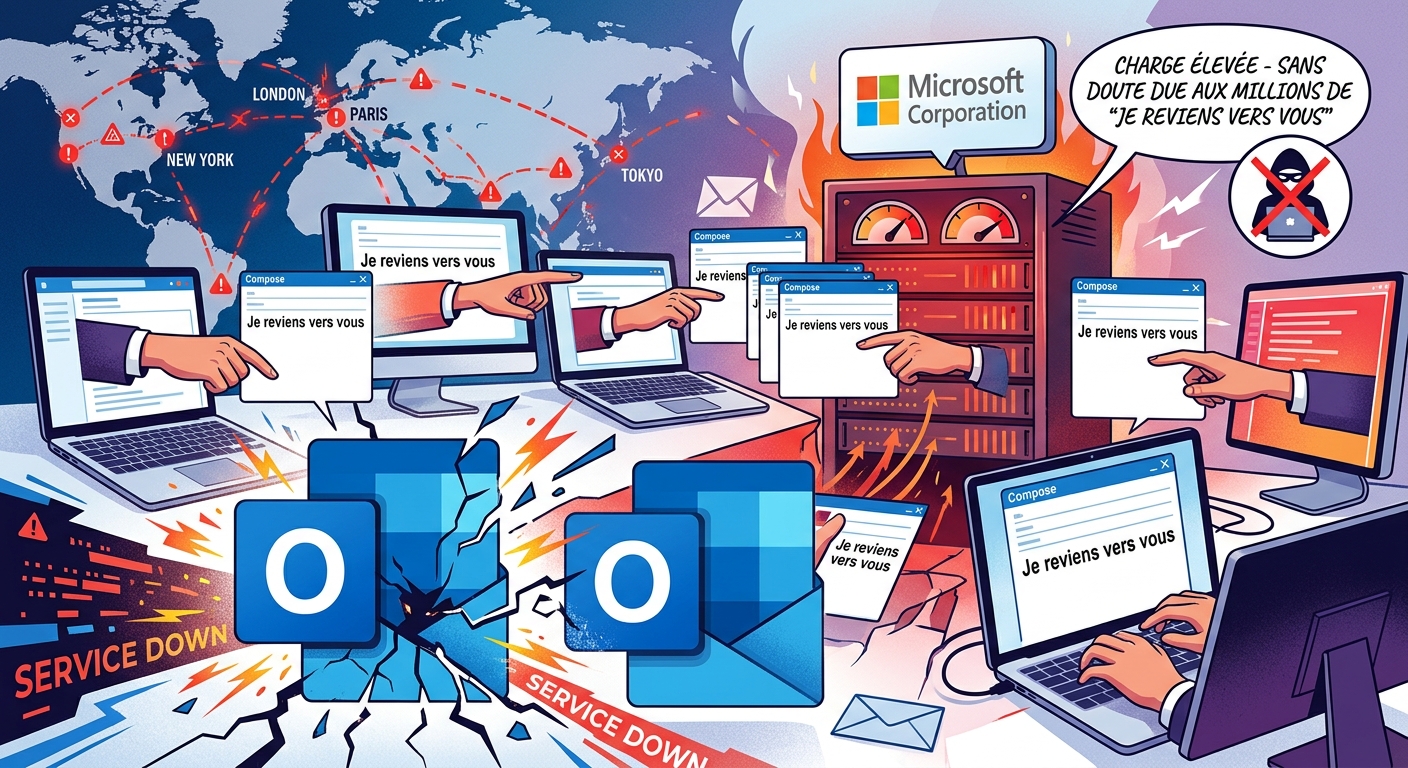
- A global outage has hit Outlook, Teams and Copilot in dozens of countries. Microsoft has ruled out an attack on its email service.
- The US tech giant cites "high load" on its infrastructure and reports early "positive results," without offering a timeline for full restoration.
- The direct consequence, according to our newsroom: millions of employees are discovering, aghast, that they are capable of thinking without a 30-minute meeting getting in the way.
📖 The Lead
It is a silence office humanity had not heard since the invention of the "Reply All" button. In dozens of countries, Outlook, Teams and Copilot simultaneously stopped working, plunging open-plan offices into a stupor bordering on mindfulness meditation. Microsoft, which rules out any attack, attributes the incident to "high load" on its infrastructure. Our newsroom, which has no technical expertise whatsoever but plenty of intuition, suspects a critical build-up of emails opening with "Just following up on my previous message" and attachments named "final_version_V7_REALLY_final.pptx." The company speaks of early "positive results." A reassuring phrase, which users had to read on another channel, being unable to open their inboxes.
💡 Exclusive Testimony
An entirely fictional character, much like work-life balance.
Gérard-Hubert, 54, "Head of Transversal Synergies" at a company whose line of business he has never quite understood, receives us, dazed, in front of a desperately empty screen. "At first, I thought it was a bug. Then I thought it was a miracle. At 10:15, I had no meetings. At 10:30, still nothing. I panicked: I had to work." Cut off from Teams, he tried to reach a colleague sitting three meters away. "I stood up. I spoke to him. With my mouth. He answered in real time, with no 'typing…' indicator. It was unspeakably brutal." Without Copilot, Gérard-Hubert also had to write a full sentence on his own. "It had a subject, a verb and an idea. I have no idea where it came from." He is now considering setting up a psychological support unit, which he plans to organize… via Outlook invitation, as soon as service is restored.
⚖️ Multi-Angle Analysis / Explainer
- On the one hand: business-continuity worriers point out, with a seriousness we commend, that companies' dependence on a handful of centralized platforms is a genuine vulnerability. When a single provider hosts the email, the video calls and now the assistant meant to summarize them, a bit of "high load" is enough to turn the global economy into a waiting room. Microsoft has so far set no timeline for a return to normal, and everyone can see just how much modern productivity hangs by a thread — or rather, by a server.
- On the other hand: a growing fringe of imaginary economists argues that the outage triggered a spectacular surge in productivity, along with a drop in "Quick catch-up?" emails, which are never quick, never brief and never actually catch anyone up. Some managers reportedly even discovered that their teams could make progress without minutes from the prep meeting for the kickoff meeting. A hypothesis deemed "deeply destabilizing" by project management departments.
🔮 Outlook & Conclusion
Services will eventually return, bringing with them the backlog of notifications, follow-ups and "Weekly Sync" invitations. Microsoft speaks of "positive results": the question is, for whom? Future historians may remember this day as the one when humanity briefly glimpsed a world free of meetings that could have been an email, and of emails that need never have existed. In the meantime, companies promise to learn from the incident at a major lessons-learned seminar. The invitation will go out via Outlook. As soon as possible. With a read receipt.
 Install AIGOCRATIE